Tuesday, January 25, 2011

why wont apk tool recompile?

if you are getting strange errors related to resources. for example:
W: Could not find sources
I: Checking whether resources has changed...
I: Building resources...
C:\someapp\res\values\public.xml:2395: error: Public entry identifier 0x107001d entry index is larger than available symbols (index 29, total symbols 29).
C:\someapp\res\values\public.xml:2395: error: Public symbol array/carrier_properties declared here is not defined.
Exception in thread "main" brut.androlib.AndrolibException: brut.common.BrutException: could not exec command: [aapt, p, -F, C:\Users\Soontir\AppData\Local\Temp\APKTOOL5080969896487671571.tmp, -x, -S, C:\someapp\res, -M, C:\framework\framework-res1\AndroidManifest.xml]
        at brut.androlib.res.AndrolibResources.aaptPackage(Unknown Source)
        at brut.androlib.Androlib.buildResourcesFull(Unknown Source)
        at brut.androlib.Androlib.buildResources(Unknown Source)
        at brut.androlib.Androlib.build(Unknown Source)
        at brut.androlib.Androlib.build(Unknown Source)
        at brut.apktool.Main.cmdBuild(Unknown Source)
        at brut.apktool.Main.main(Unknown Source)
Caused by: brut.common.BrutException: could not exec command: [aapt, p, -F, C:\Users\Soontir\AppData\Local\Temp\APKTOOL5080969896487671571.tmp, -x, -S, C:\framework\framework-res1\res, -M, C:\someapp\AndroidManifest.xml]
        at brut.util.OS.exec(Unknown Source)
        ... 7 more
the problem could be non-standard resource qualifiers. it affects current versions of apktool (1.3.2), but may be fixed in a later version. the solution is to decomile using --keep-broken-res and fix the xml file manually. for an explanation of how to do this, read this issue by the developer himself: http://code.google.com/p/android-apktool/issues/detail?id=128#c1

why wont google maps work after resigning or recompiling?

this is because access to google's stuff requires an api key, stored in xml as a resource or perhaps in code, that is linked with the certificate of the app. if you modified and resigned it, the certificate is different and will not match the api key. you will have to get a valid key for the signature you are using.

you should already have your own certificate you sign everything with. this way if you release an updated version of the app, users of your previous modified version can update without needing to uninstall the old one first. if you don't already have your own certificate, follow the directions here: Signing Your Applications | Android Developers. you will need to use keytool and examples are given in the link.

once you're done or if you already have your own certificate, follow the instructions here: Obtaining a Maps API Key - Google Projects for Android.

when finished with that, and you have your own api key, decompile your apk with apktool so you can modify resources. you are looking for an xml file with a string like:
android:apiKey="3BCknOWFD_vyechU238a1f9YOWyYP2Z91CEfQWw"

or if it is created dynamically in code, you will see the initialization of a mapview object. the constructor takes a string as the second parameter which is the api key. here's an example:
# replace p2 with our api key here:
const-string p2, "3BCknOWFD_vyechU238a1f9YOWyYP2Z91CEfQWw"

# create the mapview object with our modified api key
# this line should already be here and doesn't need to be changed
invoke-direct {p0, p1, p2}, Lcom/google/android/maps/MapView;-><init>(Landroid/content/Context;Ljava/lang/String;)V

Sunday, January 23, 2011

anti-cracking example

there are only a handful of anti-cracking techniques for android, at least that i know of. this seems to be because of how android apps must behave. they must operate inside their own virtual machine and are not allowed to store permenent data. when they are uninstalled, they must remove all traces of themselves. this makes things like timed trials difficult to implement because a simple reinstall will reset timers.

if an app wants to prevent cracking, it only has a few options. it can check file properties of the apk such as file size, last modified date and signature. it could also check the installer package name to test if it was installed via market. a cracker or pirate would install via adb, not market. antilvl can already hook and subvert signature checks. file size, last modified and installer package hooking are in the works. :D

this is what a installer package check may look like in java:
private boolean InstalledFromMarketEasy() {
  String pname = this.getPackageName();
  PackageManager pm = this.getPackageManager();
  String installPM = pm.getInstallerPackageName(pname);
 
  if ( installPM == null ) {
    // Definitely not installed from Android Market
    return false;
  }
  else if ( installPM.equals("com.google.android.feedback") ) {
    // Installed from the Android Market
    return true;
  }

  return false;
}


but there's another way to perform any check in a more clever way that makes detection more difficult... by using java reflection. instead of calling the method directly, the app could use reflection to store the method in a variable and call it later indirectly. this makes searching for the direct method call difficult. it also allows the method name to be obfuscated since it is just a strong. let me show you in code what it may look like:
const-class v1, Landroid/content/pm/PackageManager;

# do not assume this will not always be a plain text
# it could be put together in a much more complicated way such as building character by character using ascii codes
# you'll have to hook reflection methods to test the name or figure it out manually
const-string v2, "getInstallerPackageName"

# make array of size 1
const/4 v3, 0x1
new-array v3, v3, [Ljava/lang/Class;

const/4 v4, 0x0
const-class v5, Ljava/lang/String;

# store String class in array v3, at index v4 (0)
aput-object v5, v3, v4

# get method of name v2 ("getInstallerPackageName") and move to v0
# http://download.oracle.com/javase/1.5.0/docs/api/java/lang/Class.html#getMethod(java.lang.String, java.lang.Class...)
invoke-virtual {v1, v2, v3}, Ljava/lang/Class;->getMethod(Ljava/lang/String;[Ljava/lang/Class;)Ljava/lang/reflect/Method;
move-result-object v0

# do something with v0, like store in class variable
# ....
# and then sometime later, somewhere else in code

# get the package manager and store in v1
invoke-virtual {p0}, Lcom/clever/app/Main;->getPackageManager()Landroid/content/pm/PackageManager;
move-result-object v1

const/4 v2, 0x1
new-array v2, v2, [Ljava/lang/Object;

const/4 v3, 0x0
invoke-virtual {p0}, Lcom/clever/app/Main;->getPackageName()Ljava/lang/String;
move-result-object v4

# put package name in array v2 at index v3 (0)
aput-object v4, v2, v3

# actually call "getInstallerPackageName" with the array we built as parameters
# which contains this package name
# http://download.oracle.com/javase/1.5.0/docs/api/java/lang/reflect/Method.html#invoke%28java.lang.Object,(java.lang.Object...)
invoke-virtual {v0, v1, v2}, Ljava/lang/reflect/Method;->invoke(Ljava/lang/Object;[Ljava/lang/Object;)Ljava/lang/Object;
move-result-object v0
check-cast v0, Ljava/lang/String;

# clever to not use any type of full string, just "goog"
# remember the full string is expected to be "com.google.android.feedback"
const-string v1, "goog"
invoke-virtual {v0, v1}, Ljava/lang/String;->indexOf(Ljava/lang/String;)I
move-result v0

# check to see if v0 has the correct value. if not... error :D

the next lesson in way of the android cracker will cover all anti-cracking techniques i know in detail, and antilvl will support these types of checks soon, but this is enough for anyone to figure it out. :D

for some more information on reflection:
Using Java Reflection
Java programming dynamics, Part 2: Introducing reflection

Saturday, January 22, 2011

antilvl 1.0

antilvl 1.0 is finished and ready for action. here are some changes:
  • complete rewrite of previous versions
  • acts more like an engine, with modification information stored in fingerprints.xml
  • many, many more apk files can be decompiled and recompiled
  • handles several new types of protection methods
  • signature checking, a common anti-tampering technique, is subverted
  • file size / last modification checks are more accurately detected
  • pro / full unlock app protection is correctly handled sometimes
  • much more compact / optimized java bytecode

you can pick it up here: http://androidcracking.blogspot.com/p/antilvl_01.html

doing a total rewrite has opened up many more possibilities for new ideas. the next major thing i plan to implement is complete file size / last modified hooking.

Monday, January 10, 2011

upcoming antilvl 1.0

it's been a while since my last update, so i figure i should say something about progress on antilvl 1.0.

i wanted to learn all kinds of best practices in java, so i spent a lot of time designing classes while trying to avoid coupling and other oop pitfalls. even threw in some unit testing. i also want antilvl to be able to be able to learn how to subvert any implementation of the lvl, and do it without having pages and pages of complicated regex code.

to accomplish this, antilvl's code will be more like an engine, with all file identification patterns and code modification information written in xml with a specification of my own design. it will be mature enough to have in-place dynamic variables and definable search patterns. the result will be almost any apk modification could be cleverly constructed inside the xml without touching the code in about 10-20 lines.

i must stress i'm not doing this for piracy. i'm doing it because it's a challenge. no one else has done it. it's really fun for me. if i was trying to be a pirate, i would not explain how the cracks work. if you're a developer and you insist on protection, you will have to roll your own and heavily modify the official lvl so known methods will not work. use antilvl to help you figure out if it's well protected.

most people don't mind paying a few euros for a program on what amounts to their main computing device. the benefit from spending many hours on increased protection may not be worth it unless your App is very expensive. or perhaps your and android master and just really get off to having wonderfully insane levels of protection.

Monday, January 3, 2011

example-structures.smali

many people find this blog by searching for smali syntax examples and finding a previous post on example smali syntax. since i originally hastily wrote it, i have learned more so i updated it as best i could for now. more helpfully, i worked out a syntax highlighter for smali using syntaxhighlighter. i'll upload it somewhere official when i'm finished so others can use it. because i know there are throngs of people just itching to have highlighted smali code!

so for the googler's out there trying to make sense of smali, here's example-structures.smali from lesson 1 from way of the android cracker.

.class public Lcom/lohan/crackme1/example;
.super Ljava/lang/Object;
.source "example.java"


# static fields
.field private static Counter:I


# direct methods
# all the constructor does is set Counter to 0x10 (or 16)
.method public constructor <init>()V
    .registers 2

    .prologue
    .line 11
    invoke-direct {p0}, Ljava/lang/Object;-><init>()V

    const/16 v0, 0x10
    sput v0, Lcom/lohan/crackme1/example;->Counter:I

    return-void
.end method

.method public static ArrayExample()V
    .registers 4

    .prologue
    const/4 v3, 0x1
    const/4 v2, 0x0

    .line 50
    const/4 v1, 0x5

    new-array v0, v1, [Ljava/lang/String;

    .line 52
    .local v0, someArray:[Ljava/lang/String;

    # put value v1 inside array v0 at index v2 (0x0)
    const-string v1, "set value at index 0"
    aput-object v1, v0, v2

    .line 53
    # put value v1 inside array v0 at index v3 (0x1)
    const-string v1, "index 1 has this value"
    aput-object v1, v0, v3

    .line 55
    # store in v1 the value from array v0 at index v2
    aget-object v1, v0, v2

    # store in v2 the value from array v0 at index v3
    aget-object v2, v0, v3

    # compare two strings
    invoke-virtual {v1, v2}, Ljava/lang/String;->equals(Ljava/lang/Object;)Z
    move-result v1

    # if equals() returns 0, it means they are not equal, so just return
    if-eqz v1, :cond_1e

    .line 57
    sget-object v1, Ljava/lang/System;->out:Ljava/io/PrintStream;
    const-string v2, "array at index 0 = 1 (wont happen)"
    invoke-virtual {v1, v2}, Ljava/io/PrintStream;->println(Ljava/lang/String;)V

    .line 59
    :cond_1e
    return-void
.end method

# loop from 0 to Counter
# just a few lines in java
.method public static LoopExample()V
    .registers 4

    .prologue
    .line 15
    const/4 v0, 0x0

    .local v0, i:I
    :goto_1
    sget v1, Lcom/lohan/crackme1/example;->Counter:I

    if-lt v0, v1, :cond_6

    .line 17
    return-void

    .line 16
    :cond_6
    sget-object v1, Ljava/lang/System;->out:Ljava/io/PrintStream;

    new-instance v2, Ljava/lang/StringBuilder;
    const-string v3, "current val for loop: "
    invoke-direct {v2, v3}, Ljava/lang/StringBuilder;-><init>(Ljava/lang/String;)V
    invoke-virtual {v2, v0}, Ljava/lang/StringBuilder;->append(I)Ljava/lang/StringBuilder;
    move-result-object v2

    invoke-virtual {v2}, Ljava/lang/StringBuilder;->toString()Ljava/lang/String;
    move-result-object v2

    invoke-virtual {v1, v2}, Ljava/io/PrintStream;->println(Ljava/lang/String;)V

    .line 15
    add-int/lit8 v0, v0, 0x1

    goto :goto_1
.end method

.method public static SwitchExample()V
    .registers 3

    .prologue
    .line 21
    const/16 v0, 0x2a

    .line 22
    .local v0, val:I
    
    # begin the switch
    # look down at .sparse_switch directive
    sparse-switch v0, :sswitch_data_2e

    # switch default just passes through to here
    .line 27
    sget-object v1, Ljava/lang/System;->out:Ljava/io/PrintStream;
    const-string v2, "invalid value"
    invoke-virtual {v1, v2}, Ljava/io/PrintStream;->println(Ljava/lang/String;)V

    .line 29
    :goto_c
    return-void

    .line 23
    :sswitch_d # if v0 is 1, we'll be here
    sget-object v1, Ljava/lang/System;->out:Ljava/io/PrintStream;
    const-string v2, "val 1"
    invoke-virtual {v1, v2}, Ljava/io/PrintStream;->println(Ljava/lang/String;)V
    goto :goto_c

    .line 24
    :sswitch_15 # if v0 is 2
    sget-object v1, Ljava/lang/System;->out:Ljava/io/PrintStream;
    const-string v2, "val 2"
    invoke-virtual {v1, v2}, Ljava/io/PrintStream;->println(Ljava/lang/String;)V
    goto :goto_c

    .line 25
    :sswitch_1d # if v0 is 42
    sget-object v1, Ljava/lang/System;->out:Ljava/io/PrintStream;
    const-string v2, "val 42"
    invoke-virtual {v1, v2}, Ljava/io/PrintStream;->println(Ljava/lang/String;)V
    goto :goto_c

    .line 26
    :sswitch_25 # if v0 is 5
    sget-object v1, Ljava/lang/System;->out:Ljava/io/PrintStream;
    const-string v2, "val 5"
    invoke-virtual {v1, v2}, Ljava/io/PrintStream;->println(Ljava/lang/String;)V
    goto :goto_c

    .line 22
    nop

    :sswitch_data_2e
    # if v0 is 0x1 goto :sswitch_d
    # if 0x2 :sswitch_15
    # and so on...
    .sparse-switch
        0x1 -> :sswitch_d   # 1
        0x2 -> :sswitch_15  # 2
        0x5 -> :sswitch_25  # 5
        0x2a -> :sswitch_1d # 42
    .end sparse-switch
.end method

.method public static TryCatchExample()V
    .registers 8

    .prologue
    const-string v7, ": "

    .line 33
    const-string v3, "google.com"

    .line 36
    .local v3, urlStr:Ljava/lang/String;
    # begin try here
    :try_start_4
    new-instance v2, Ljava/net/URL;

    invoke-direct {v2, v3}, Ljava/net/URL;-><init>(Ljava/lang/String;)V

    .line 37
    .local v2, url:Ljava/net/URL;
    invoke-virtual {v2}, Ljava/net/URL;->openStream()Ljava/io/InputStream;

    move-result-object v1

    .line 38
    .local v1, is:Ljava/io/InputStream;
    invoke-virtual {v1}, Ljava/io/InputStream;->close()V
    :try_end_10
    # end of the try
    
     # if there was a MalformedURLException, goto :catch_11
    .catch Ljava/net/MalformedURLException; {:try_start_4 .. :try_end_10} :catch_11
    
    # IOException goes to :catch_36
    .catch Ljava/io/IOException; {:try_start_4 .. :try_end_10} :catch_36

    # if NO exception, just pass through:
    .line 46
    .end local v1           #is:Ljava/io/InputStream;
    .end local v2           #url:Ljava/net/URL;
    :goto_10
    return-void

    .line 39
    :catch_11
    # move the exception to v4, then to v0
    # all of the code below is what happens with an exception
    move-exception v4
    move-object v0, v4

    .line 41
    .local v0, e:Ljava/net/MalformedURLException;
    sget-object v4, Ljava/lang/System;->out:Ljava/io/PrintStream;

    new-instance v5, Ljava/lang/StringBuilder;
    const-string v6, "Invalid URL "
    invoke-direct {v5, v6}, Ljava/lang/StringBuilder;-><init>(Ljava/lang/String;)V
    invoke-virtual {v5, v3}, Ljava/lang/StringBuilder;->append(Ljava/lang/String;)Ljava/lang/StringBuilder;
    move-result-object v5

    const-string v6, ": "
    invoke-virtual {v5, v7}, Ljava/lang/StringBuilder;->append(Ljava/lang/String;)Ljava/lang/StringBuilder;
    move-result-object v5

    invoke-virtual {v0}, Ljava/net/MalformedURLException;->getMessage()Ljava/lang/String;
    move-result-object v6

    invoke-virtual {v5, v6}, Ljava/lang/StringBuilder;->append(Ljava/lang/String;)Ljava/lang/StringBuilder;
    move-result-object v5

    invoke-virtual {v5}, Ljava/lang/StringBuilder;->toString()Ljava/lang/String;
    move-result-object v5

    invoke-virtual {v4, v5}, Ljava/io/PrintStream;->println(Ljava/lang/String;)V

    goto :goto_10

    .line 42
    .end local v0           #e:Ljava/net/MalformedURLException;
    # end exception code
    
    # begin exception code    
    :catch_36
    move-exception v4
    move-object v0, v4

    .line 44
    .local v0, e:Ljava/io/IOException;
    sget-object v4, Ljava/lang/System;->out:Ljava/io/PrintStream;

    new-instance v5, Ljava/lang/StringBuilder;
    const-string v6, "Unable to execute "
    invoke-direct {v5, v6}, Ljava/lang/StringBuilder;-><init>(Ljava/lang/String;)V
    invoke-virtual {v5, v3}, Ljava/lang/StringBuilder;->append(Ljava/lang/String;)Ljava/lang/StringBuilder;
    move-result-object v5

    const-string v6, ": "
    invoke-virtual {v5, v7}, Ljava/lang/StringBuilder;->append(Ljava/lang/String;)Ljava/lang/StringBuilder;
    move-result-object v5

    invoke-virtual {v0}, Ljava/io/IOException;->getMessage()Ljava/lang/String;
    move-result-object v6

    invoke-virtual {v5, v6}, Ljava/lang/StringBuilder;->append(Ljava/lang/String;)Ljava/lang/StringBuilder;
    move-result-object v5

    invoke-virtual {v5}, Ljava/lang/StringBuilder;->toString()Ljava/lang/String;
    move-result-object v5

    invoke-virtual {v4, v5}, Ljava/io/PrintStream;->println(Ljava/lang/String;)V

    goto :goto_10
    # end exception code
.end method

Wednesday, December 29, 2010

getting apk signature outside of android

one way to circumvent signature checking in an android app is to spoof with the correct signature (usually a hashcode but sometimes a tochar representation). but how do we get the apk signature? well, we could write a program in android to do it, which is pretty simple:
public void WriteSignature(String packageName)
{
 // all of this is fairly well documented
 // if it doesn't work, just search around.
 
 PackageManager pm = this.getPackageManager();
 PackageInfo pi = null;
 try {
  pi = pm.getPackageInfo(packageName, PackageManager.GET_SIGNATURES);
 } catch (NameNotFoundException e1) {
  e1.printStackTrace();
 }
 Signature[] s = pi.signatures;
 
 // you can use toChars or get the hashcode, whatever
 String sig = new String(s[0].toChars());

 try {
  File root = Environment.getExternalStorageDirectory();
  if ( root.canWrite() )
  {
   // toChars is long, so i write it to a file on the external storage
   File f = new File(root, "signature.txt");
   FileWriter fw = new FileWriter(f);
   BufferedWriter out = new BufferedWriter(fw);
   out.write(packageName + "\nSignature: " + sig);
   out.close();
   fw.close();
  }
 } catch (IOException e) {
  e.printStackTrace();
 }
}

but i wanted to be able to get the signature from my computer, and google wasn't helping. so i dug into the android code. then i found this: http://grepcode.com/file/repository.grepcode.com/java/ext/com.google.android/android/2.0_r1/android/content/pm/PackageParser.java#442

the packageparser code was exactly what i needed. nothing about it was particularly magical and i could have probably figured it out on my own if i knew java.security better, but here is what i came up with:
import java.io.IOException;
import java.io.InputStream;
import java.lang.ref.WeakReference;
import java.security.Signature;
import java.security.cert.*;
import java.util.Enumeration;
import java.util.jar.JarEntry;
import java.util.jar.JarFile;
import java.util.logging.Level;
import java.util.logging.Logger;

public class Main {

 private static final Object mSync = new Object();
 private static WeakReference<byte[]> mReadBuffer;

 public static void main(String[] args) {
  if (args.length < 1) {
   System.out.println("Usage: java -jar GetAndroidSig.jar <apk/jar>");
   System.exit(-1);
  }

  System.out.println(args[0]);

  String mArchiveSourcePath = args[0];

  WeakReference<byte[]> readBufferRef;
  byte[] readBuffer = null;
  synchronized (mSync) {
   readBufferRef = mReadBuffer;
   if (readBufferRef != null) {
    mReadBuffer = null;
    readBuffer = readBufferRef.get();
   }
   if (readBuffer == null) {
    readBuffer = new byte[8192];
    readBufferRef = new WeakReference<byte[]>(readBuffer);
   }
  }

  try {
   JarFile jarFile = new JarFile(mArchiveSourcePath);
   java.security.cert.Certificate[] certs = null;

   Enumeration entries = jarFile.entries();
   while (entries.hasMoreElements()) {
    JarEntry je = (JarEntry) entries.nextElement();
    if (je.isDirectory()) {
     continue;
    }
    if (je.getName().startsWith("META-INF/")) {
     continue;
    }
    java.security.cert.Certificate[] localCerts = loadCertificates(jarFile, je, readBuffer);
    if (false) {
     System.out.println("File " + mArchiveSourcePath + " entry " + je.getName()
         + ": certs=" + certs + " ("
         + (certs != null ? certs.length : 0) + ")");
    }
    if (localCerts == null) {
     System.err.println("Package has no certificates at entry "
         + je.getName() + "; ignoring!");
     jarFile.close();
     return;
    } else if (certs == null) {
     certs = localCerts;
    } else {
     // Ensure all certificates match.
     for (int i = 0; i < certs.length; i++) {
      boolean found = false;
      for (int j = 0; j < localCerts.length; j++) {
       if (certs[i] != null
           && certs[i].equals(localCerts[j])) {
        found = true;
        break;
       }
      }
      if (!found || certs.length != localCerts.length) {
       System.err.println("Package has mismatched certificates at entry "
           + je.getName() + "; ignoring!");
       jarFile.close();
       return; // false
      }
     }
    }
   }

   jarFile.close();

   synchronized (mSync) {
    mReadBuffer = readBufferRef;
   }

   if (certs != null && certs.length > 0) {
    final int N = certs.length;
    
    for (int i = 0; i < N; i++) {
     String charSig = new String(toChars(certs[i].getEncoded()));
     System.out.println("Cert#: " + i + "  Type:" + certs[i].getType()
      + "\nPublic key: " + certs[i].getPublicKey()
      + "\nHash code: " + certs[i].hashCode()
       + " / 0x" + Integer.toHexString(certs[i].hashCode())
      + "\nTo char: " + charSig);
    }
   } else {
    System.err.println("Package has no certificates; ignoring!");
    return;
   }
  } catch (CertificateEncodingException ex) {
   Logger.getLogger(Main.class.getName()).log(Level.SEVERE, null, ex);
  } catch (IOException e) {
   System.err.println("Exception reading " + mArchiveSourcePath + "\n" + e);
   return;
  } catch (RuntimeException e) {
   System.err.println("Exception reading " + mArchiveSourcePath + "\n" + e);
   return;
  }
 }

 private static char[] toChars(byte[] mSignature) {
    byte[] sig = mSignature;
    final int N = sig.length;
    final int N2 = N*2;
    char[] text = new char[N2];

    for (int j=0; j<N; j++) {
      byte v = sig[j];
      int d = (v>>4)&0xf;
      text[j*2] = (char)(d >= 10 ? ('a' + d - 10) : ('0' + d));
      d = v&0xf;
      text[j*2+1] = (char)(d >= 10 ? ('a' + d - 10) : ('0' + d));
    }

    return text;
    }

 private static java.security.cert.Certificate[] loadCertificates(JarFile jarFile, JarEntry je, byte[] readBuffer) {
  try {
   // We must read the stream for the JarEntry to retrieve
   // its certificates.
   InputStream is = jarFile.getInputStream(je);
   while (is.read(readBuffer, 0, readBuffer.length) != -1) {
    // not using
   }
   is.close();

   return (java.security.cert.Certificate[]) (je != null ? je.getCertificates() : null);
  } catch (IOException e) {
   System.err.println("Exception reading " + je.getName() + " in "
       + jarFile.getName() + ": " + e);
  }
  return null;
 }
}

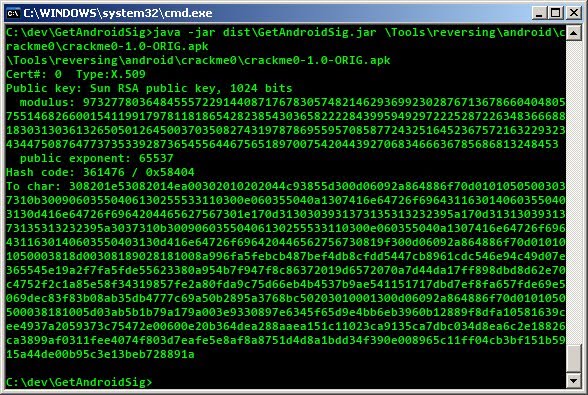
running it on crackme0 from way of the android cracker 0, produces this:


using it, in dalvik, would look something like this:
# get signatures array
iget-object v0, v0, Landroid/content/pm/PackageInfo;->signatures:[Landroid/content/pm/Signature;

# get element at index v10 in array v0 and store in v0
aget-object v0, v0, v10
 
# call Signature.hashCode() on v0, returns an integer
invoke-virtual {v0}, Landroid/content/pm/Signature;->hashCode()I
move-result v9

# spoof original signature hashcode. grin smugly.
const/16 v9, 0x58404